
Craft
The Kitchen Work Triangle Is Built for One Cook
The kitchen work triangle is treated as a timeless rule. It was built in the 1940s for one cook in a small galley — and almost no one cooks that way now.
Every kitchen designer learns the work triangle on day one. Draw a line between the sink, the cooktop, and the refrigerator; keep each leg between four and nine feet; protect the shape from foot traffic. Do that, the rule promises, and the kitchen will work.
It is the most durable idea in kitchen design, and it is quietly the wrong one for most of the kitchens being built today. The kitchen work triangle was engineered to solve a problem almost no one has anymore.
That problem was a single cook, working alone, in a small room.
The kitchen work triangle solved a 1940s problem
The triangle was formalized by the University of Illinois Small Homes Council in the 1940s, building on the 1920s time-and-motion studies of industrial psychologist Lillian Gilbreth. Its purpose was not luxury. It was efficiency and cost: builders wanted the cheapest, tightest layout that let one homemaker move between three stations without wasted steps. The council tested its ideas across more than 10,000 apartments.
Read that back. The triangle is a postwar, space-saving standard for a compact galley with one person in it. The kitchen it was built for had no island, no second sink, and no one else in the room. It was a workstation, not a gathering place.
One cook is now the exception
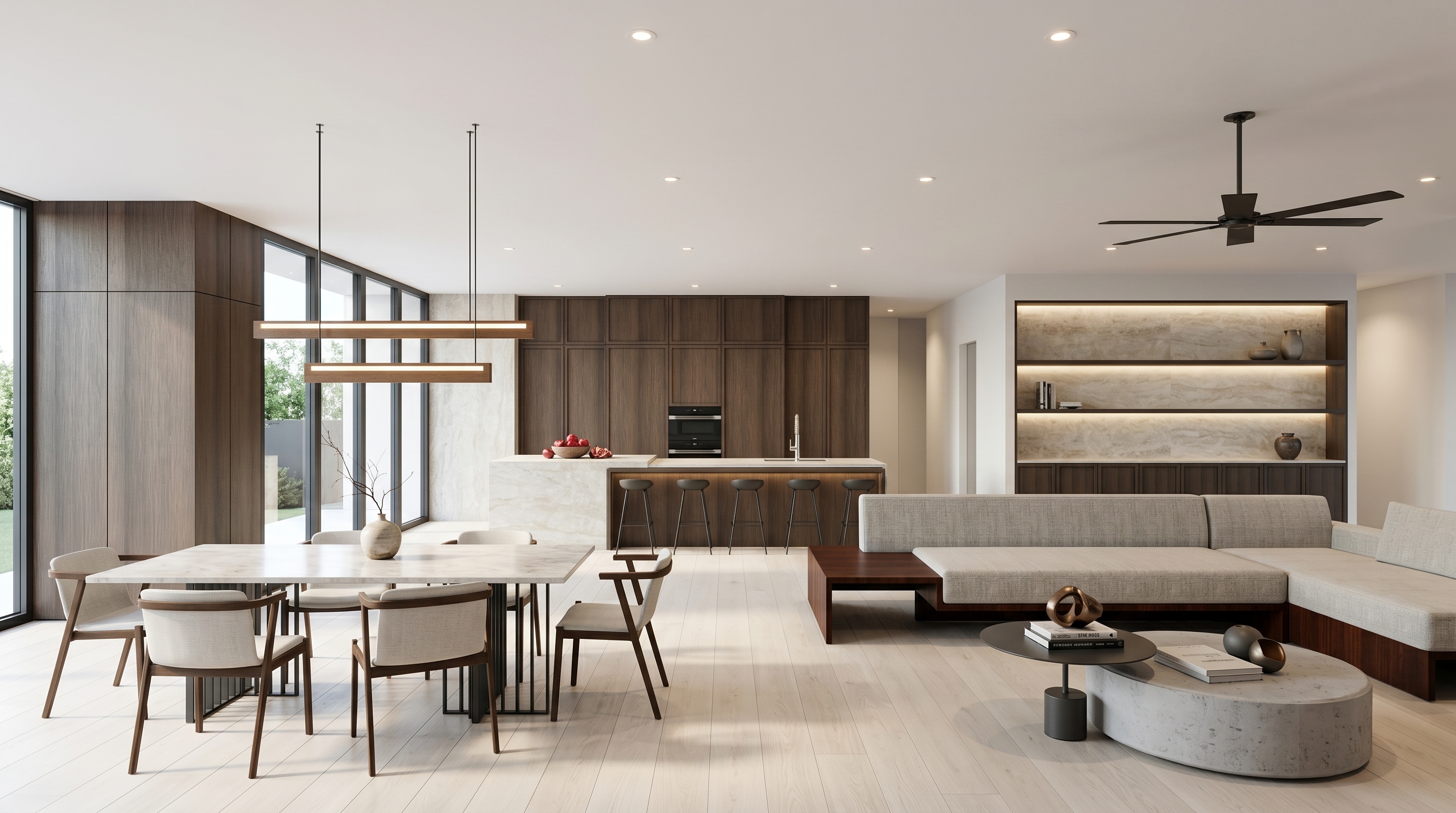
The modern kitchen is open to the living space, sized for company, and routinely worked by more than one person at once. The triangle has no answer for the second cook — the partner chopping while you sear, the child doing homework at the island, the guest pouring wine in the exact spot the rule says must stay clear.
The trade noticed. When the National Kitchen & Bath Association rewrote its design guidelines, it did not crown the triangle; it widened the lens. Its current guidance talks in terms of a work route and dedicated zones — prep, cooking, cleanup, storage, serving — and specifies wider aisles for shared use: at least 42 inches for one cook, 48 for two. A single tidy triangle cannot describe a room that real households now use in parallel.
Why the triangle survives anyway
It persists because it is easy to teach and easy to sell. Three points and three lines fit on a napkin; zones require you to actually study how a specific family cooks. The triangle lets a designer skip that conversation. That is precisely the problem with it. A rule simple enough to apply without thinking is a rule that stops you from thinking.
Design the zones, then let the triangle fall where it may
Stop drawing the triangle first. Start by mapping the work your household actually does, then give each task its own zone with its tools and surfaces close at hand: a prep zone near the bin and the knives, a cooking zone with landing space on both sides of the heat, a cleanup zone that keeps the dishwasher clear of the main run, and a coffee or breakfast zone that lives outside the cooking path entirely. Plan the aisles for two bodies, not one. If a clean triangle emerges from that, good — but it should be the result of the layout, not the cause of it. It is the same discipline behind the way we approach kitchen design, and the reason the island is so often the piece that goes wrong.
The work triangle was a genuinely good answer — to a question from the 1940s. The kitchens worth building now hold more than one cook and more than one purpose, and they ask a better question: not how short the path is for one person, but how gracefully the room works when it is full.
See it for yourself
If this changed how you are thinking about your kitchen layout, the next step is not another article. Book a private showroom tour and spend an hour with our design team, one on one, walking through how your kitchen will actually be used — not how a mid-century diagram says it should be. Our studios, from Chicago to New York, are built for exactly that conversation. Reserve a private tour.