
Craft
Your Outdoor Kitchen Grill Shouldn't Be Gas Alone
The gas grill anchors every luxury outdoor kitchen. But premium buyers have already split for live fire — here's how to plan an outdoor kitchen grill that lasts.
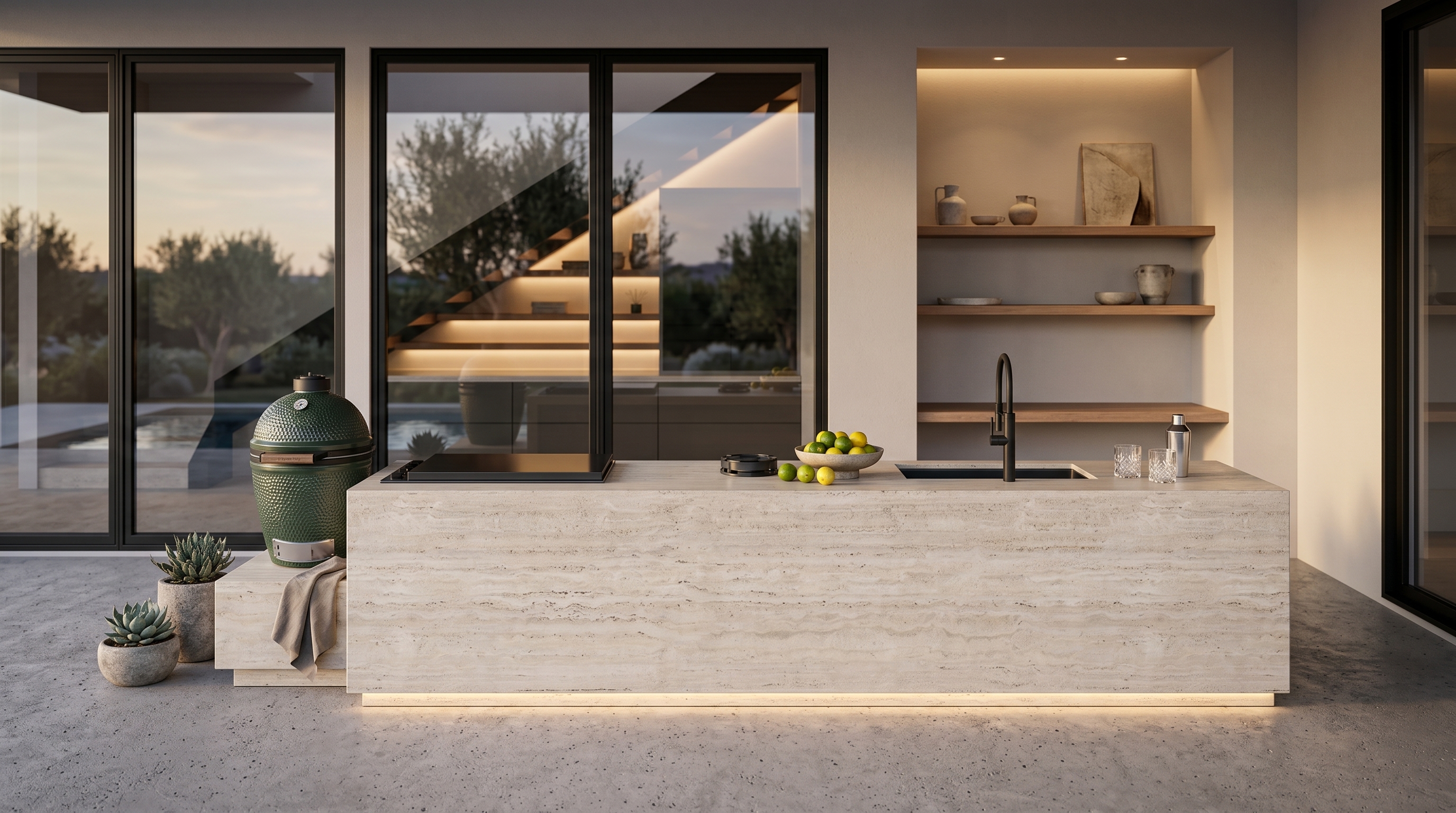
The luxury outdoor kitchen has a fixed centerpiece, and everyone already knows what it is: a wide stainless gas grill, dropped into a run of masonry, lid gleaming. Specify one and the project feels finished before it has started.
It is also the decision most likely to date the whole kitchen. Cementing a single gas grill into stone commits the most permanent part of the build to the least permanent idea in it — the assumption that convenience is the only thing an outdoor kitchen grill needs to deliver.
The people who cook seriously outdoors stopped believing that a while ago. The premium market has quietly split its loyalty, and it has split toward fire.
The premium market already went both ways
The Hearth, Patio & Barbecue Association's study of mid-to-high-end grill owners found 61% cook on propane — and 59% cook on charcoal or wood. That is not a gas market with a charcoal fringe. That is a dead heat. Asked what fuel they want on their next premium grill, 67% said both.
So the single fixed gas grill is not the safe, neutral default it looks like on a plan. It answers a question two-thirds of your likely buyers have stopped asking. They want a way to make fire, not just a way to avoid it.
Gas is the convenience. Fire is the reason.
Gas earns its keep on a Tuesday. It lights fast, holds a temperature, and cleans up without ceremony — which is exactly why nearly two-thirds of gas grill owners bolt on a side burner and treat the thing as an outdoor stove.
But nobody photographs a Tuesday. The meals people build an outdoor kitchen for — the long Saturday, the dinner cooked standing over coals — are live-fire meals. The current wave of Argentine parrillas and Santa Maria rigs, pushed into the mainstream by wood-fired steakhouses and chefs who cook on nothing else, is not nostalgia. It is the plain recognition that radiant heat off hardwood does something to food a burner cannot fake.
A gas grill cooks dinner. A fire is the reason everyone came outside.
The grill is the part you will want to change
There is a structural argument for holding the centerpiece loosely. The masonry, the stone counter, the cabinetry — those are twenty-year decisions. The grill is not. Industry buying guides put a freestanding grill's working life at roughly three to ten years, and even a well-built drop-in is the component you are most likely to outgrow, upgrade, or want to swap for a different kind of cooking entirely.
These are not display pieces. Premium owners spend an average of $10,600 on an outdoor kitchen, and 73% of them use it at least three times a week. A space worked that hard should be built around how its owner actually cooks — not around the appliance that looks most expensive in the rendering. Our own case for restraint runs the same direction: the fully loaded outdoor kitchen tends to be overbuilt, and the fixed gas grill is where the overbuilding usually begins.
Build the kitchen so the cooking surface can change and you protect the expensive, permanent parts from the cheap, fast-moving one. Weld yourself to one brand's gas cutout and every future change means a demolition.
How to specify an outdoor kitchen grill
Plan the outdoor kitchen around a fuel strategy, not a single box. In practice that is one of two moves. Design the primary cooking zone to accept more than one surface — a gas grill for weeknights set beside a charcoal or wood insert. Or engineer a deliberate bay for live fire now, even if the parrilla goes in later, so adding it does not mean tearing out stone.
Either way: size the counter and clearances for two kinds of cooking, vent for solid fuel from the start, and stop treating the gas unit as the immovable heart of the room. It is an appliance. The kitchen is the architecture.
The gas grill will always have a place in a serious outdoor kitchen. It just should not be the entire plan, set in stone. Build for fire and you build for the meals people actually remember — and for the way they will want to cook a decade from now.
Book a private showroom tour
If this changed how you are thinking about your outdoor kitchen grill, the next step is not another article. Book a private showroom tour and spend an hour with our design team, one on one — walking a full outdoor system in person at one of our showrooms, from Atlanta to Dallas to Los Angeles, and planning a kitchen built around how you actually cook.