
Craft
Cabinet Edge Banding Decides Your Kitchen's Lifespan
Door style gets all the attention, but cabinet edge banding decides whether a kitchen actually survives a decade of steam, spills, and dishwasher heat.
Ask someone why they chose their kitchen cabinets and you will hear about the door style, the finish, maybe the hardware. Nobody mentions the edge banding, the thin strip of material sealing the raw edges of the cabinet box, because nobody thinks to ask about it and most showrooms never bring it up.
That is the mistake. Cabinet edge banding, and specifically the adhesive holding it in place, is a better predictor of whether a kitchen survives ten years near a dishwasher than the wood species stamped on the door front. The finish is what you are shown. The bond line is what actually gets tested, every time steam rolls off a pot or a glass sweats on the counter.
Most buyers never see this decision get made, because it happens at the factory, months before installation, in a choice between two adhesive families that look identical on a spec sheet and behave nothing alike in a working kitchen.
The Glue Line Behind Your Cabinet Edge Banding
Edge banding itself, whether PVC, ABS, acrylic, or real wood veneer, is bonded to the cabinet box with hot-melt adhesive, and the two dominant families are EVA and PUR (polyurethane). EVA is the industry default: cheaper, easier to apply, and it re-melts if it gets hot again, which is exactly what happens above a dishwasher or beside a range. PUR cures through a reaction with ambient humidity into a bond that reference sources on edge banding materials and industry press both describe as substantially more heat- and moisture-resistant once fully set.
Woodshop News, the trade publication for professional woodworkers, puts it plainly: PUR forms a bond that is relatively heat and moisture resistant, which is why it shows up by default in bathroom cabinetry and lab furniture, anywhere the adhesive will meet water or heat repeatedly. A kitchen sink base, a dishwasher surround, and an island near a steam-heavy range are exactly that environment. Most stock and mid-market cabinetry still ships with EVA, because it costs a third as much and nobody is asking to see the resin spec.
Why the Kitchen Finds the Weak Seam First
Every room punishes materials differently, and a kitchen is unusually hard on adhesive. It cycles between damp and dry faster than almost anywhere else in the house, thanks to dishwasher steam, pot boil-over, and condensation on cold glass. An EVA bond softens under sustained heat and can start to lift at the seam within a few years in exactly those spots: under the sink, beside the dishwasher, behind a wall oven. The door still looks perfect. The box behind it is quietly delaminating.
It is also why the same complaint turns up so often in kitchen renovations that looked flawless at handoff: peeling edges appear two or three years in, always in the same handful of locations, and always traceable to a glue choice made before the client ever saw a sample door.
German Manufacturing Treats This as a Structural Spec
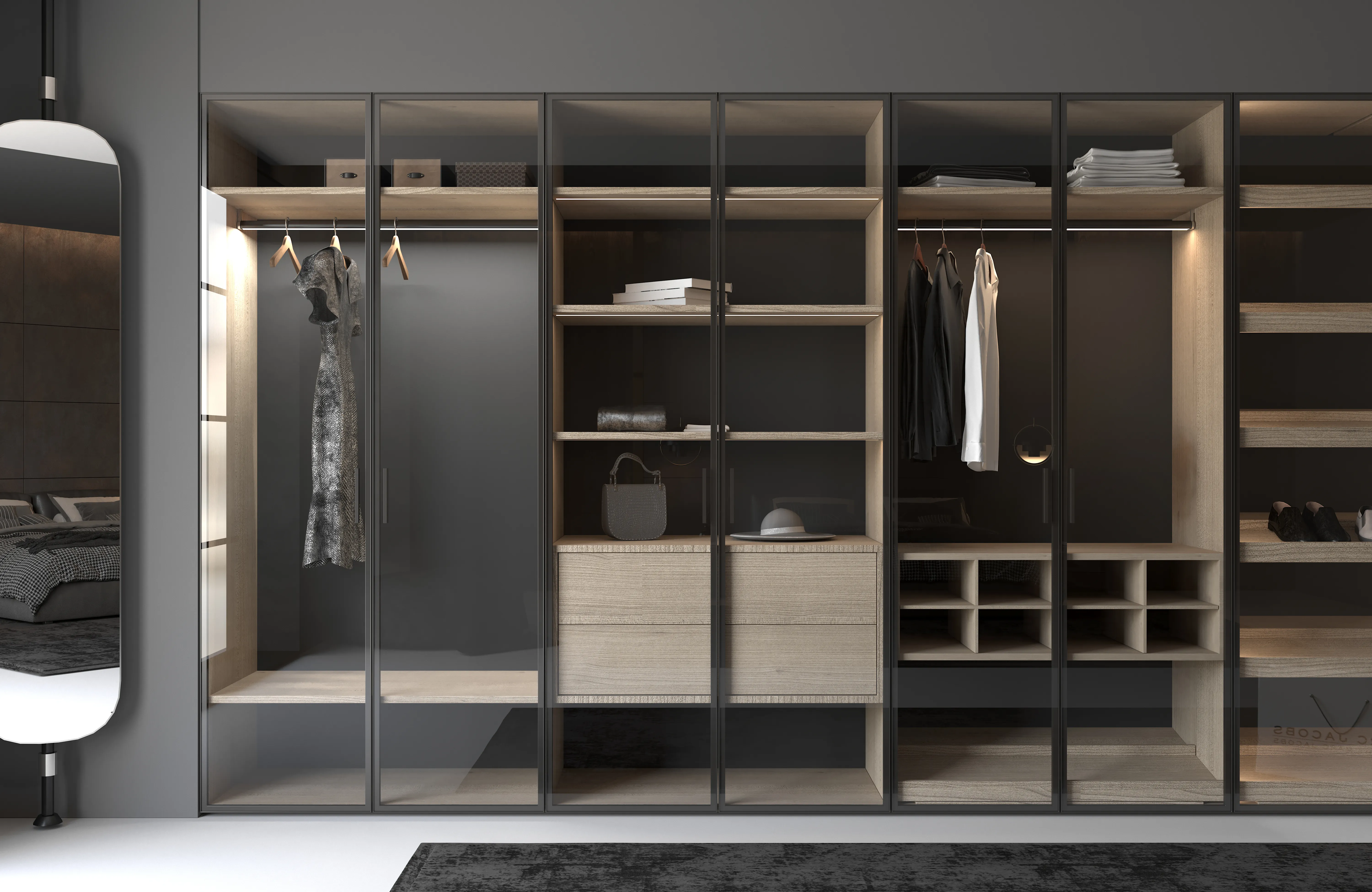
In higher-tier European cabinet manufacturing, edge banding adhesive is not a finishing decision, it is a structural one, specified the way a builder specifies flashing around a window rather than a paint color. The bond has to hold in a wet-zone cabinet for decades, not survive a showroom floor for a season. That is a different design brief than most mass manufacturing works from, where cost per linear foot of banding is the number that gets optimized. The same logic applies to closet cabinetry near a laundry room or an ensuite, where humidity swings are just as real even though nobody expects them there.
Ask to See the Underside, Not the Door
Before you sign off on any kitchen, skip the wood species and door profile questions for a moment and ask what adhesive the cabinet manufacturer uses on the edge banding, specifically whether it is a reactive PUR hot-melt or standard EVA. Then check it yourself: on any display cabinet, run a fingernail along the edge seam near a sink or dishwasher cutout. A PUR bond feels seamless and rigid. An EVA bond often shows a faint ridge or gives slightly under pressure, a preview of what heat and moisture will do to it over time. It is a thirty-second test that tells you more about a kitchen's real lifespan than an hour spent comparing finishes.
A kitchen's finish is what sells it. Its edge banding is what keeps it looking sold ten years later. Ask about the seam before you ask about the stain.
Book a Private Showroom Tour
If this changed how you are evaluating a kitchen, the next step is not another spec sheet, it is an hour with a design consultant who can show you the difference in person. BauTeam runs private showroom tours across eight U.S. cities, from Boston to Los Angeles, with no templates and no pressure. Reserve your private tour and see how the details you cannot see are the ones that matter most.