
Craft
The Best Cabinet Finish Never Sees a Brush
The hand-painted kitchen reads as craft, but the most durable cabinet finish is sprayed and cured in a factory — never brushed on at your house.
A certain kind of luxury kitchen is sold on the romance of the brush. The story goes that a person, not a machine, laid the paint on your cabinets by hand, and that the faint softness of a brushed surface is the fingerprint of craft. It is a lovely story. It also describes the finish most likely to fail first.
The most durable cabinet finish is not brushed on in your house by an artisan. It is sprayed in a controlled room and chemically cured before the doors ever reach your kitchen. The hand you are paying to admire is, in finishing, the weak link.
Craft in a cabinet finish is real. It simply lives in the parts you never see performed — the chemistry, the film thickness, the dust-free air — and almost none of it happens with a brush.
The only real test grades the factory finish
There is exactly one recognized durability standard for kitchen and bath cabinets in North America, ANSI/KCMA A161.1, and it is worth knowing what it does to a finish. A door goes into a hotbox at 120 degrees Fahrenheit and 70 percent humidity for a full day, then into a coldbox at minus 5. Its exposed faces are left under vinegar, lemon, orange and grape juice, ketchup, coffee, olive oil and 100-proof alcohol for 24 hours, and under mustard for one.
The standard describes these as the accelerated equivalent of years of normal kitchen life — and it grades them on pre-finished cabinets. In other words, the benchmark the whole industry points to assumes the finish arrived from a factory. A coat brushed on at your house, after the boxes are hung, is never asked to survive anything remotely like it.
Drying is not curing
The romance of the brush hides a chemistry problem. A one-part lacquer or paint hardens by letting its solvent evaporate. It dries. A catalyzed conversion varnish — two parts, with a hardener measured in before it is sprayed — cross-links on a molecular level. It cures. Those are not two grades of the same thing; they are different events.
A cured film is markedly harder and thicker than a dried one, more elastic as the wood moves with the seasons, and far more resistant to water, kitchen chemicals, and yellowing. Finishers broadly regard catalyzed conversion varnish as the most durable finish available for wood cabinetry. It is also, not coincidentally, a spray product. The brush tends to go hand in hand with the softer one-part paints that can be brushed at all — the ones that dry beautifully and never reach that hardness.
A finish fails where the air is dirty
Even the right coating is only as good as the room it is applied in, and this is where the on-site brush loses on points it cannot win back. A factory booth gives a finish filtered, dust-free air and a set temperature and humidity, so nothing settles into the wet film and the cure happens the same way every time. A kitchen mid-renovation gives it sanding dust, a swinging thermostat, and whatever the weather is doing. Even Fine Homebuilding, in a piece on getting good results with a spray gun, concedes that working in a house “may lack the repeatable convenience of a dedicated, shop-based spray booth.”
Then there is color. The resins in oil-based enamels oxidize and drift from white toward cream and yellow, and the shift shows worst on light colors in low light — the inside of a door, the back of a corner, precisely the surfaces you open every day. A white kitchen brushed in an oil-based paint is, in a real sense, engineered to go yellow exactly where you will notice.
How to judge a cabinet finish before you buy
The romance is not the thing to inspect. Four questions predict the next twenty years better than any brushstroke:
- Is the finish factory-applied — sprayed and cured before delivery — or coated on site after the cabinets are installed?
- Is the topcoat a two-part catalyzed finish such as conversion varnish, or a one-part paint that only air-dries?
- What controls the room it is finished in — filtered air, a set temperature and humidity, or none of the above?
- For anything white or pale, is the resin one that resists yellowing, or an oil-based enamel that will amber in the dark?
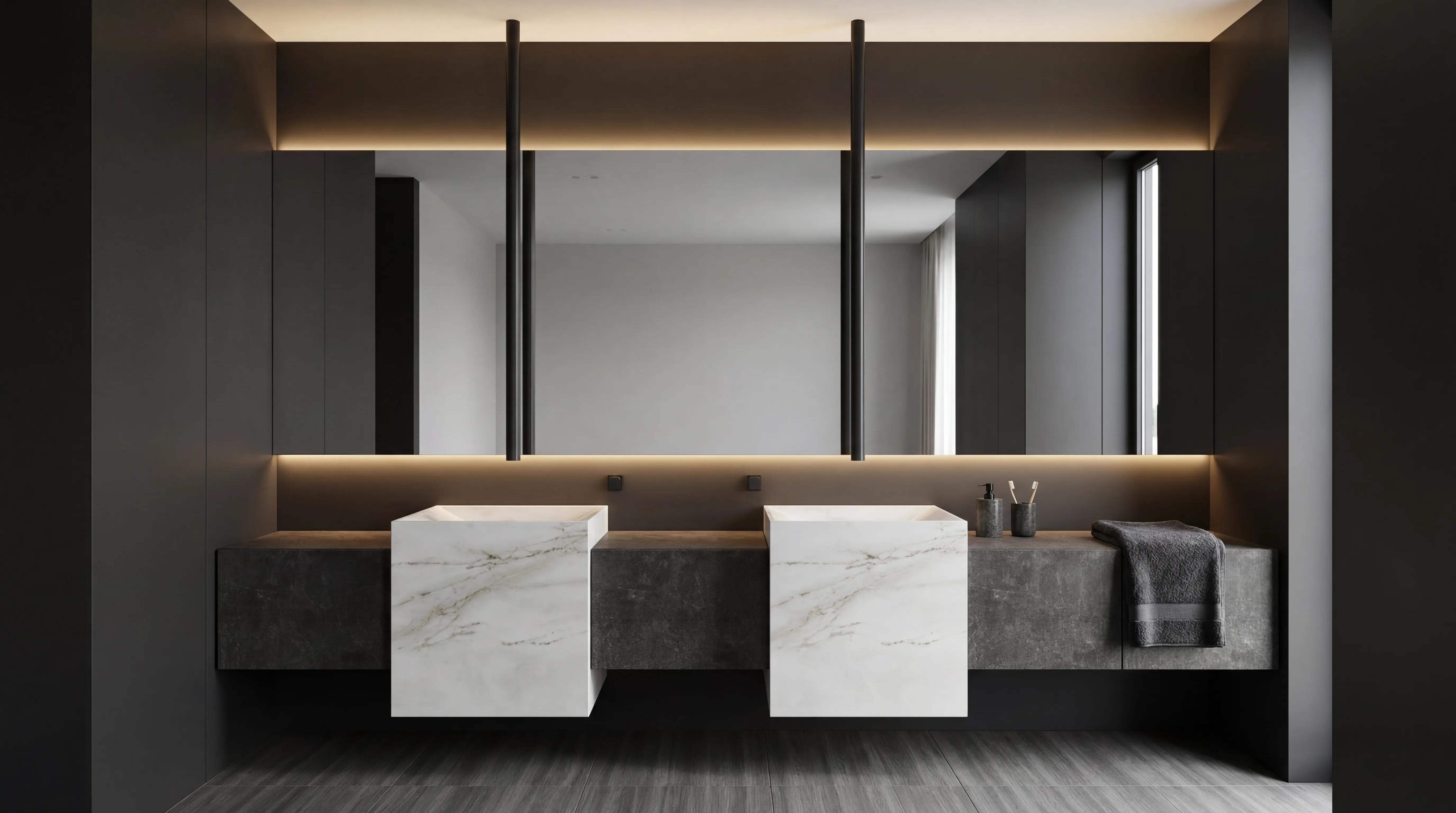
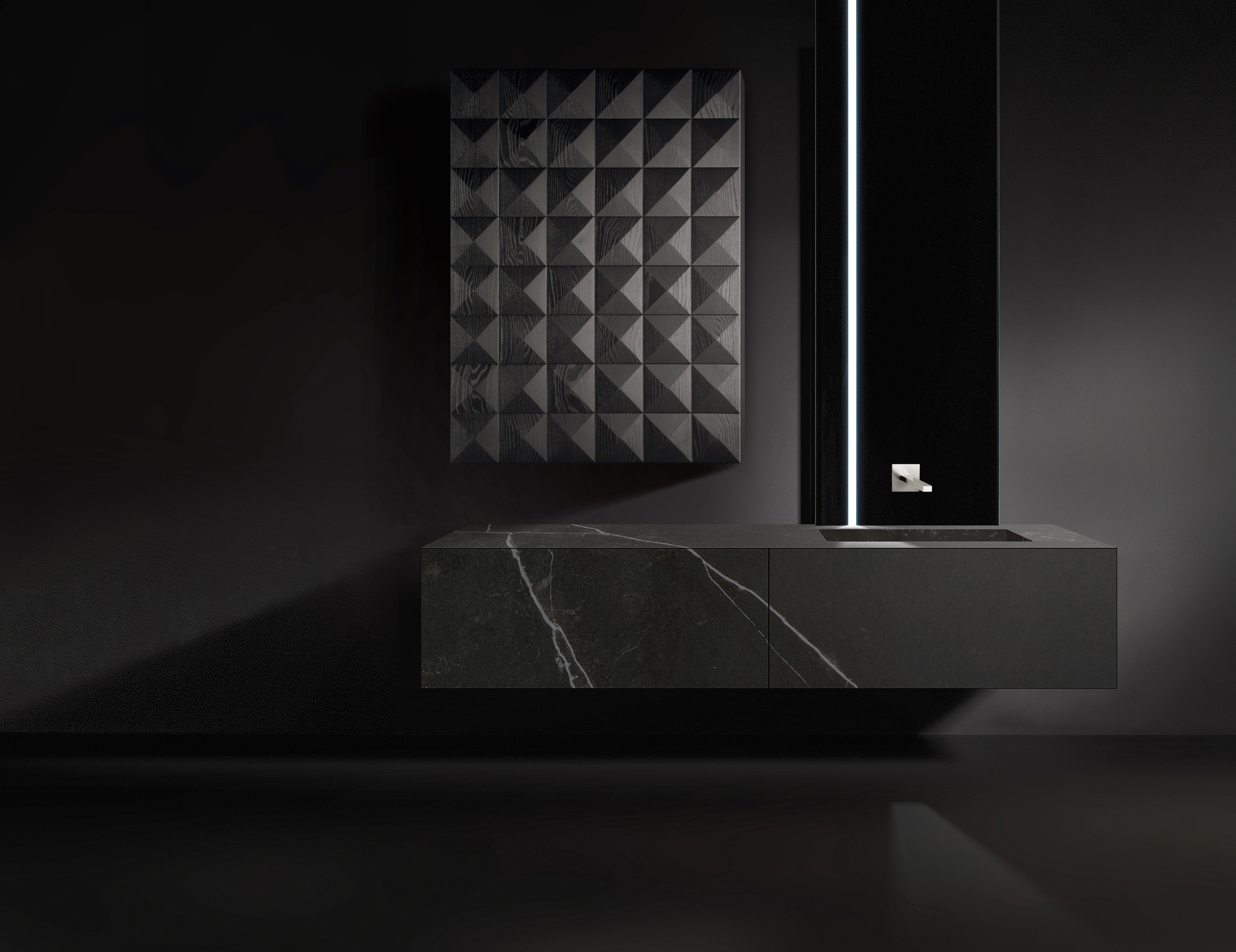
This is the logic behind a factory-cured matte lacquer on a German kitchen, and behind the same finishes carried onto a vanity: the surface is resolved in clean air, under a hardener, long before it reaches your home.
The point
The brushstroke you were taught to look for is the one thing a finish is better off without. The craft that lasts is invisible — a cured film, laid down in clean air, doing its work in silence for two decades. Admire the surface that shows you nothing: no marks, no story, no yellow in the corners.
Book a private showroom tour
If this changed how you read a finish spec, the next step is not another article. Book a private showroom tour and spend an hour with our design team, one on one — run your hand across a factory-cured lacquer and feel what a finish is like when the brush never touched it. Our studios run from Buckhead and Boston’s Back Bay to Chicago, Dallas, Las Vegas, Los Angeles, and SoHo.