
Craft
The Black Outdoor Kitchen Countertop Is a Griddle
The dark outdoor kitchen countertop looks timeless and cooks in the afternoon sun. Why a lighter, honed stone is the smarter call, and how to test it.
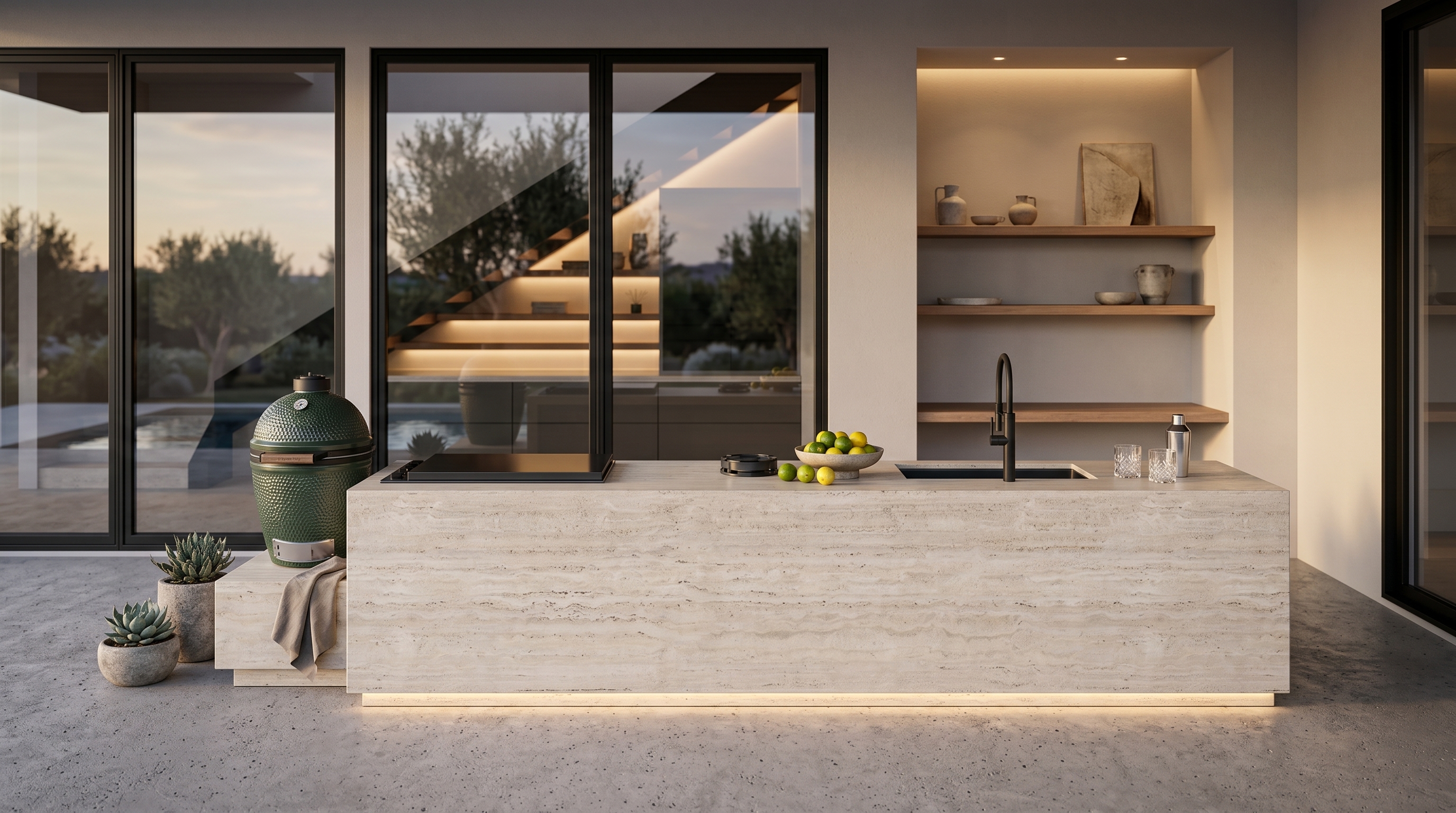
Ask a designer for the safe, durable choice in an outdoor kitchen and the answer is usually black granite. It reads as serious. It hides stains. It photographs beautifully against a wall of greenery. It is also, for a good part of the summer afternoon, a cooking surface.
The dark outdoor kitchen countertop has become the default because nobody argues with it, not because anyone tested it. Put the same slab in direct sun and the conversation changes, and the people who feel the change are the ones leaning an elbow on it while the burgers rest.
Why the Outdoor Kitchen Countertop Runs Hot
The physics isn't subtle. The U.S. Environmental Protection Agency notes in its heat island compendium that the sun can heat dry, exposed surfaces to 50 to 90°F hotter than the surrounding air, and that darker surfaces tend to reflect less sunlight than lighter ones. On a 90-degree day, that arithmetic puts a dark horizontal surface well past the point of comfort.
A Phoenix remodeler's 2026 analysis puts numbers on it for stone: a black granite patio counter around 145°F at mid-afternoon in July, against roughly 100°F for a light beige granite. That is an extreme climate and a secondary source, so treat the exact figures as directional. The gap, about 20 to 25°C by the same analysis, is the part that travels to every sunny patio.
Warm Is Not the Same as Hot
Skin does not wait for a surface to reach boiling. An engineering summary of ASTM C 1055, the guide for surfaces that cause contact burns, from Exponent, lists 52 to 56°C (126 to 133°F) as the range of maximum pain, and 60 to 64°C (140 to 147°F) as the range where tissue shows mottled red and white damage. It also notes that the time to damage roughly halves for every degree above 44°C, up to about 51°C.
A countertop doesn't have to burn you to fail. It only has to make you take your hand away. A surface you can't rest a forearm on, set a cold drink on without sweating it warm, or let a child lean against has stopped being a counter and become a decoration.
The Lighter Stone Wins on Use, Not Just Looks
We've argued before that the wrong material outdoors fails slowly. Color fails faster. A mid-tone or light stone, honed rather than polished, holds less heat and shows less glare, and it forgives water spots and dust in a way that black never does. The darkest slab is the one that shows every ring and fingerprint, which quietly undoes the stain-hiding argument that sold it.
None of this makes dark stone forbidden. Under a deep roof overhang or a pergola with solid cover, a black counter behaves very differently from one in open sun. The question is not which color is better, but how many hours the surface sits in direct light.
Put Your Hand on It Before You Pour It
Take the sample to the exact spot where the counter will sit, at about three in the afternoon, and leave it there for an hour. Then press your palm on it for ten seconds, and a forearm for five. If you pull away, the real counter will do the same on the days you most want to use it. Ask the fabricator about a lighter or mid-tone stone with a honed finish, and map where the sun falls across the run before you choose, not after.
An outdoor kitchen is judged in July, not in the showroom. Choose the counter for the afternoon it will actually live through.
Book a Private Showroom Tour
If this changed how you're thinking about your outdoor kitchen, the next step isn't another sample swatch. It's an hour with our design team, one on one, with stone you can hold in actual light. Book a private tour at your nearest of BauTeam's eight showrooms and reserve your visit.