
Craft
The Outdoor Kitchen Sink Is the Feature You'll Regret
The outdoor kitchen sink is the most over-specified feature in the yard — rarely used, quick to freeze, and easy to skip. Here's what to build instead.
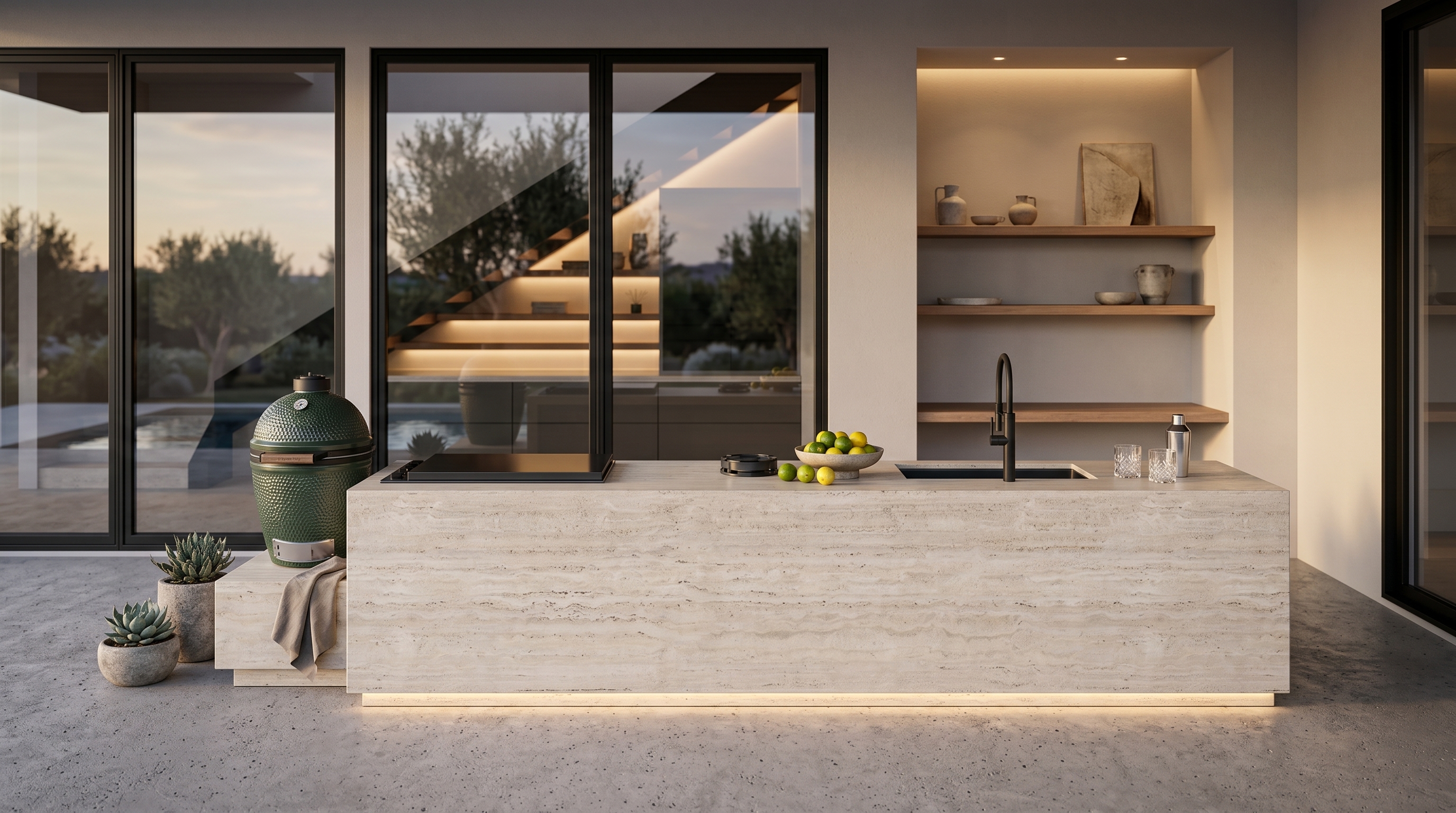
Every outdoor kitchen checklist includes it, right after the grill and the counter: a sink. Running water, the thinking goes, is what separates a real outdoor kitchen from a glorified barbecue. It is the one feature almost no one questions.
Question it. The plumbed outdoor kitchen sink is the most over-specified element in the yard — the thing clients ask for by reflex, use twice a summer, and spend the rest of the year trying to keep from bursting. For most of the country, the water line is the part of the project most likely to fail and least likely to be missed.
That is not an argument for a bare patio. It is an argument for spending the money where the hours actually go.
The math on a feature you'll barely use
Start with cost. A new outdoor sink runs roughly $215 to $1,500 installed once plumbing is included, and the water line to reach it adds $300 to $1,500 more — often $25 to $200 per linear foot, depending on how far the trench travels and what it has to cross. Drainage is another $10 to $25 per foot. Set against an average outdoor kitchen of around $16,500, the sink and its plumbing quietly become one of the larger line items, and the one you will touch least.
Water is the first thing to freeze, and the first thing to fail
The reason plumbers dread outdoor kitchens is not the sink; it is the standing water in the line. The moment temperatures drop, an outdoor supply line becomes a liability. Winterizing it is not a wipe-down — it is a procedure: shut the line, drain it, blow the remaining water out with compressed air, then pour antifreeze into the trap so the last inch of standing water cannot freeze and crack the drain. Miss one step and you find out in spring.
Frost-free sillcocks help, but they are widely misunderstood. Their internal stem closes the valve four to twelve inches back inside a heated wall, and the exposed pipe self-drains by gravity — but only if it is sloped correctly and nothing is left attached. Leaving a hose connected over winter is the single most common cause of a burst frost-free faucet, because the trapped water cannot drain. The device that is supposed to be foolproof fails for the most ordinary reason there is.
The outdoor kitchen sink also carries a code you didn't budget for
Then there is the part no one mentions at the showroom: backflow. Under the International Plumbing Code and International Residential Code, any outdoor faucet or hose connection must be protected by a vacuum breaker so contaminated water cannot siphon back into your drinking supply, and it has to sit at least six inches above the surface it serves. This is not optional, and it is not the kind of thing you discover until an inspector does. A sink is not a fixture you drop in; it is a small potable-water system with rules.
What to build instead
If you cook outdoors more than you wash dishes outdoors — and almost everyone does — put the sink budget into the two things you use every time you are out there: more uninterrupted counter beside the grill, and cold storage actually rated for the outdoors. Prep happens on the counter. Cleanup happens at the sink you already own, ten steps inside.
If you genuinely want water outside, build it honestly. Specify a self-draining, frost-free supply, slope the lines, add a dedicated shutoff and a blow-out valve so winterizing takes minutes instead of a Saturday, and get the vacuum breaker right the first time. A sink you can shut down in five minutes is worth having. One you dread every October is not. Our outdoor kitchen systems are planned around how the space is actually used, not the checklist it is supposed to satisfy.
The takeaway
The sink is the feature that makes an outdoor kitchen look complete in a rendering and feel like a chore by November. Build for the hours you will spend at the grill, not the ones you will spend draining a pipe. The most useful thing in an outdoor kitchen is usually the thing you will actually reach for.
See it before you plumb it
If this changed how you are thinking about your outdoor kitchen, the next step is not another article. Book a private showroom tour and spend an hour with our design team, one on one — in Atlanta, Boston, Dallas, Chicago, New York, or any of our studios across the country. Reserve your private tour.