
Craft
Your Outdoor Kitchen Pizza Oven Will Sit Cold
The built-in outdoor kitchen pizza oven is sold as the centerpiece. It's the appliance most likely to sit cold — a portable one bakes the same 60-second pie.
Walk through any luxury outdoor kitchen rendering and you will find it: the domed, wood-fired pizza oven, clad in something expensive, anchoring the whole composition. It is sold as the centerpiece — the object that proves this is a serious place to cook, not just a grill with ambitions.
Here is the quiet truth the renderings leave out. In most homes, the built-in outdoor kitchen pizza oven is the single appliance most likely to sit cold. Not because the owner lost interest, but because the oven's own physics argue against ever lighting it.
The best outdoor kitchens being built this year treat the pizza oven as a question, not a foregone conclusion. It is worth asking before the masonry goes in, because after that it is the most permanent decision in the yard.
The mass that cooks so well is the mass that stays cold
A masonry pizza oven works by storing heat. The fire warms not the air but the dome and floor — hundreds of pounds of refractory material that then radiate steadily onto the crust. One popular precut brick-oven kit carries roughly 2,200 pounds of dense fire brick. That thermal mass is exactly why a real wood-fired oven bakes so beautifully and holds temperature through a long night of pies.
It is also why it is so slow to wake up. From a cold start, a well-built wood-fired oven takes about ninety minutes to two and a half hours to reach operating temperature. An oven left unused for a while needs a long, patient fire just to drive the moisture back out before it is safe to run hot.
A pizza oven that takes two hours to reach temperature is not really an appliance. It is a commitment you make on Saturday morning for a dinner you will eat Saturday night. Very few households cook that deliberately more than a handful of times a year — and a five-figure fixture built for a handful of nights is a strange kind of luxury.
A countertop oven now hits the same numbers
The case for the built-in used to be simple: only real mass could reach real Neapolitan heat. The Associazione Verace Pizza Napoletana, which certifies authentic Neapolitan pizza, sets the bar at a floor of roughly 380 to 430°C and a dome near 485°C — about 905°F — with a bake of sixty to ninety seconds. For years, only a serious masonry oven could get there.
That is no longer true. Portable gas ovens from makers such as Ooni and Gozney now reach 950°F in about fifteen minutes and bake a leopard-spotted pie in roughly sixty seconds — the same target the AVPN sets for the wood-fired original. Fifteen minutes against two hours, from a box you can lift with one hand and store for the winter.
The result on the plate is close enough that the difference lives in ritual, not char. And ritual does not require two thousand pounds of brick bolted to your patio.
What the built-in outdoor kitchen pizza oven costs you
A custom masonry pizza oven generally runs from about $1,500 to $8,000, with high-end designs reaching $12,000 to $20,000 and up once you add site prep, a gas or electrical run, and the mason's time. A capable portable oven costs a few hundred dollars.
But money is the smaller cost. The larger one is footprint and permanence. A built-in oven claims a wide, deep, single-use block of your most valuable outdoor real estate — space that could have been prep counter, cold storage, or simply the room to move that most outdoor kitchens never have enough of. You are trading the thing you use every time you cook for the thing you use twice a summer.
Build the setting, not the monument
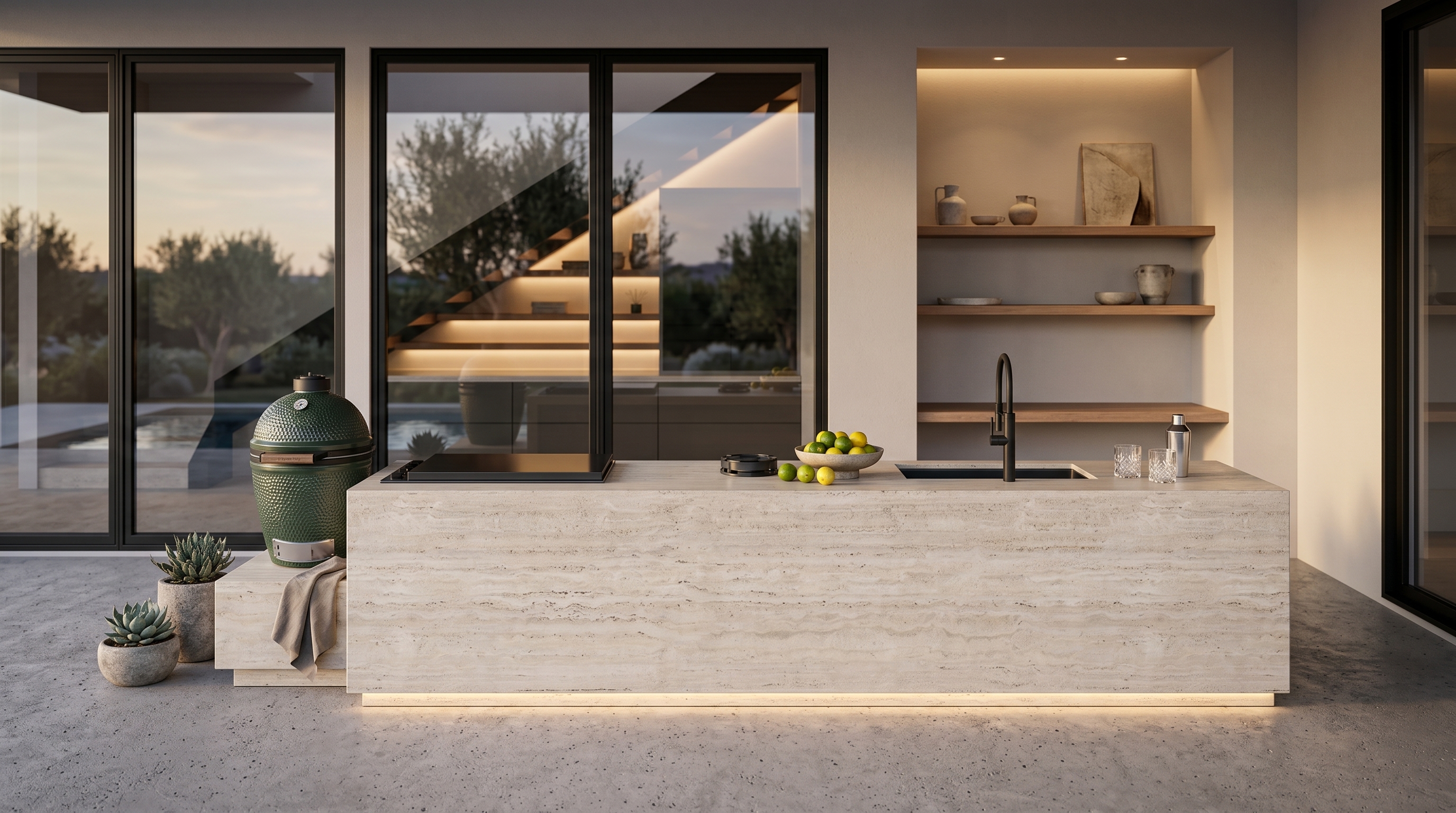
If you love the idea of pizza outdoors — and it is a good idea — build the setting for it rather than the monument. Leave a heat-rated landing zone: a run of stone or porcelain counter, a covered spot out of the wind, and a gas stub if you want fuel on tap. Then let the oven itself stay portable. You get the same 900-degree bake, the freedom to put it away, and a layout that still works on the ninety percent of nights you are grilling, not baking.
And if you genuinely are the household that bakes every week — some are — then commit to the masonry with open eyes: plan the cure, buy the cover, and site it where a two-hour fire is a pleasure rather than a chore. Build it because you will use it, not because the drawing looked incomplete without it. This is the kind of honest trade-off worth working through with a designer before anything is set in stone, and it is exactly the sort of decision our outdoor kitchen work is built around.
The dome in the rendering will always look like the heart of the kitchen. In practice, the heart of the kitchen is whatever you reach for without thinking — and almost no one reaches, without thinking, for two hours of fire.
Book a private showroom tour
If this changed how you are thinking about your outdoor kitchen, the next step is not another article. Book a private showroom tour and spend an hour with our design team, one on one, planning around how you actually cook — from our SoHo flagship in New York to the Design District studio in Dallas and studios across the country. Book a private tour.