
Craft
Your Outdoor Kitchen Is Facing the Wrong Way
The outdoor kitchen gets planned around its appliances and its view. The decision that actually determines whether it gets used is which way it faces the sun and the wind.
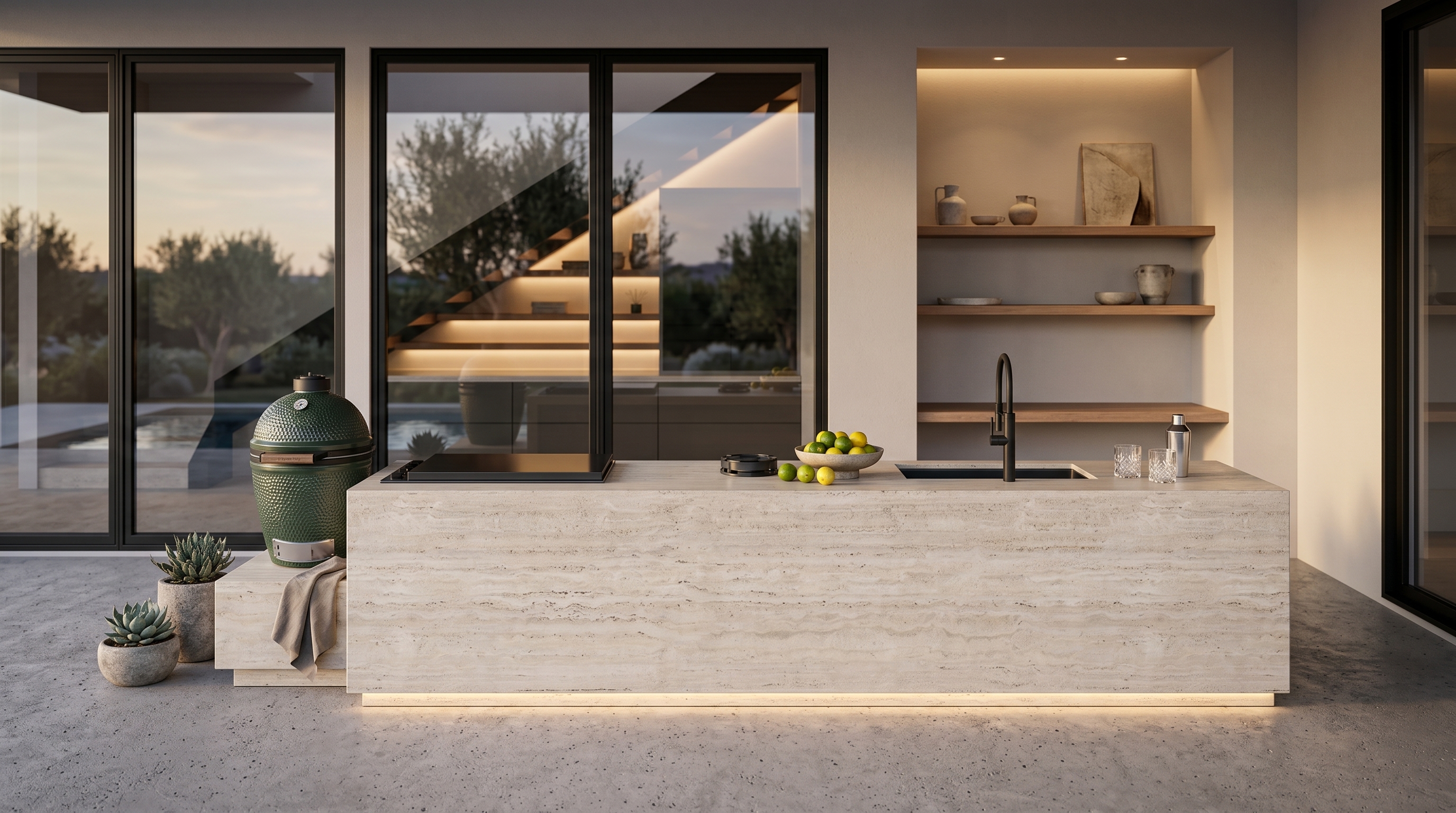
The outdoor kitchen is sold as a collection of objects. A grill with the right badge, a run of weatherproof cabinetry, a countertop chosen to photograph well, all arranged for the view off the back of the house. Spend enough on the objects, the thinking goes, and the space takes care of itself.
It doesn’t. The single decision that determines whether an outdoor kitchen gets used has almost nothing to do with the appliances. It is orientation — which way the whole thing faces the sun and the wind — and it is the one line item that rarely gets planned for at all.
Get it wrong and you build a handsome room nobody wants to stand in. Get it right and a modest setup earns its place for twenty years.
The Sun Keeps the Same Hours You Do
People cook outside in the late afternoon and into the evening. That is precisely the window in which a west-facing cook station turns against you.
Orientation, as Australia’s government Your Home guide defines it, is the position of a structure relative to the path of the sun and the prevailing wind. East- and west-facing surfaces take the most sun in the early morning and late afternoon, when the sun sits low and its light strikes at a direct angle. West-facing surfaces, the guide notes plainly, receive the strongest radiation at the hottest part of the day.
Put that on a patio. A cook facing west at seven on a July evening is staring into a low sun, over a stone counter that has been soaking up heat since two in the afternoon. No appliance upgrade solves it. The only remedies are orientation and shade — and both are settled before anything is bolted to a slab.
Smoke Has a Direction, and So Does Your Wind
The second force is wind, and it is the one that clears a patio fastest. Every site has a prevailing direction, and the difference between pleasant and unusable is often a matter of degrees.
The Your Home guidance recommends studying local breezes before you build and points out that wind can be redirected with fences, plantings and outbuildings. The application is blunt: a grill set upwind of the seating sends smoke across every guest, while the same grill turned to sit downwind vanishes from the conversation. The test costs nothing. Tie strips of light fabric to a fence, a branch and a chair, and read them across a few evenings until the pattern is obvious.
The Appliances Are the Easy Part
None of this is where the money goes. The global outdoor kitchen market reached $24.45 billion in 2024 and is projected to grow roughly 8.9% a year through 2030, according to Grand View Research. Most renovating homeowners spend around $13,000, while 22% spend more than $30,000, per the National Kitchen & Bath Association. Two-thirds of outdoor kitchens run between 100 and 400 square feet, and 88% of them center on a grill.
Those numbers describe a market buying hardware. A grill is a decision you can make in an afternoon and reverse in a weekend. The German-engineered cabinetry in a BauTeam outdoor kitchen will outlast the appliances it surrounds — but only if the whole assembly faces a direction the sun and wind agree with. Orientation is fixed the day the slab is poured. The cheapest element of the entire project, the direction it faces, is the only one that can’t be returned.
Decide Which Way Your Outdoor Kitchen Faces First
Before a single appliance is specified, spend one full day with the site. Track the shadows from noon to dusk and mark where the sun lands at cooking hour; that tells you which way the cook should face and where shade stops being optional. Read the wind across several evenings and put the grill downwind of where people sit. Then, and only then, lay out the work zones — hot, cold and wet within a few steps of one another — inside a footprint you already know the sun and wind will tolerate. A pergola, louvered roof or shade sail over a west or south exposure is not a decorative flourish; on those orientations it is the thing that makes the room usable at all.
This is also the case for an outdoor kitchen that stands apart from the house rather than pinned to the nearest wall. A freestanding footprint can be turned toward the sun and the wind, instead of toward whatever brick happens to be there.
An outdoor kitchen is not defined by what you cook on. It is defined by whether you walk outside at all. Point it away from the evening sun, set the smoke downwind, and the least expensive decision you make will be the one that keeps the space in use long after the first grill has been replaced.
Book a Private Showroom Tour
If this shifted how you’re thinking about where your outdoor kitchen should sit, the next step isn’t another article. Book a private showroom tour and spend an hour with the BauTeam design team, one on one, working through your site’s sun, wind and sightlines before a single cabinet is drawn. Our showrooms run from Dallas and Chicago to New York and Los Angeles, and every tour is unhurried and specific to your project.