
Craft
A Museum Would Never Build Your Walk-In Closet
The open-shelf walk-in closet puts your wardrobe on display — but light, dust, and open air are the three things that quietly wreck fabric. Here is what museums do instead, and how to store clothes so they still look new in twenty years.
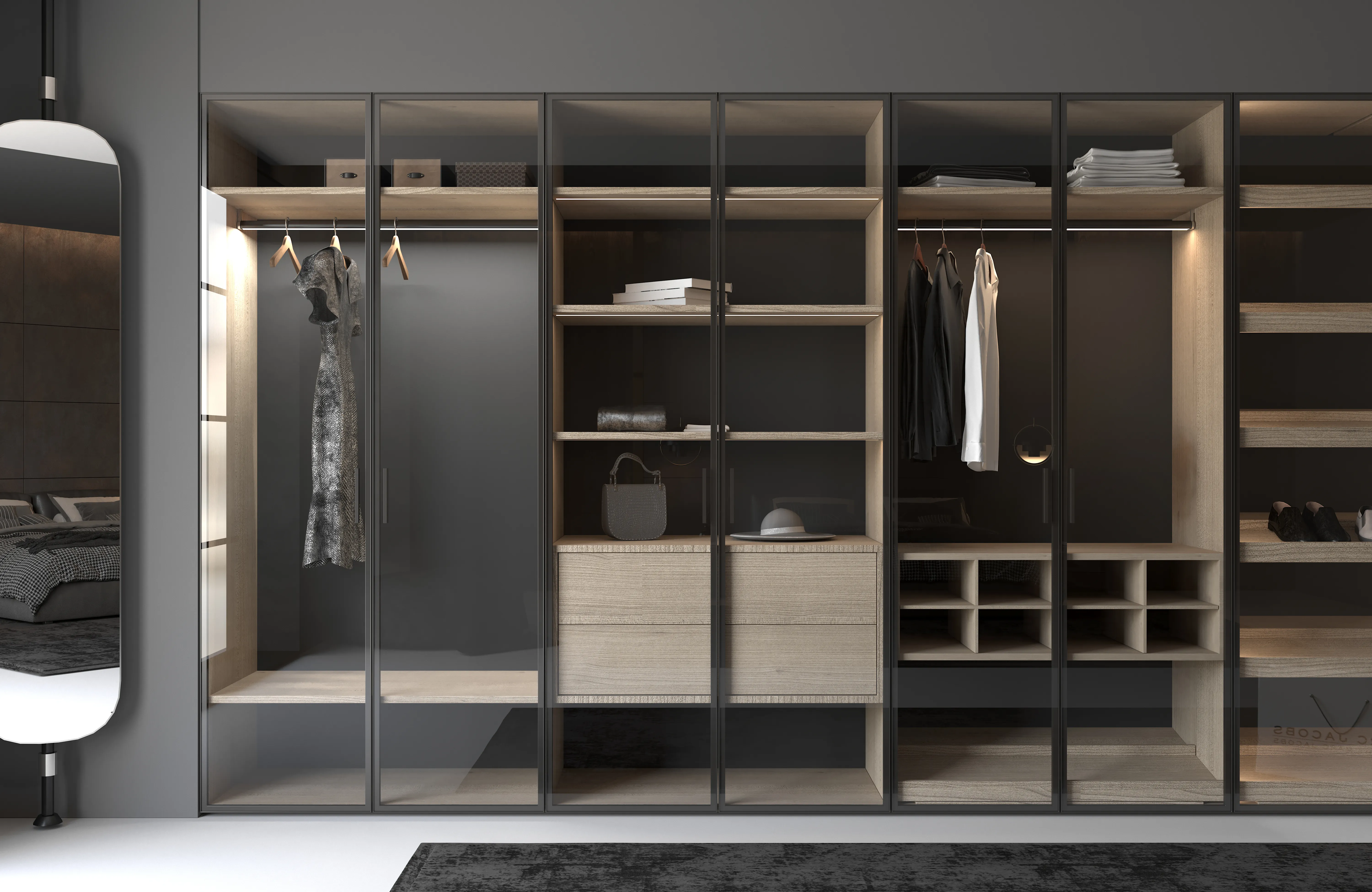
Walk into a showroom-grade walk-in closet and you are, essentially, looking at a boutique. Open shelves. Garments hung like exhibits. A small chandelier, a run of warm downlights, maybe a window framing the wardrobe in morning light. The vocabulary is retail, and it is deliberate: the closet has become a room to be seen in, not merely a place to keep clothes.
A museum would never build it. An institution whose entire job is keeping textiles intact and vivid for centuries would look at that closet and build something close to the opposite.
Because nearly everything the aspirational closet celebrates is, in conservation terms, an accelerant. The three agents that degrade fabric fastest are light, dust, and open air — and open display maximizes all three.
Light is doing damage you cannot see yet
The most counterintuitive fact about fabric is that light damage is cumulative and irreversible. The Canadian Conservation Institute measures it as illuminance multiplied by time: a garment exposed to 100 lux for 400 hours suffers exactly the same fading as one kept at 50 lux for 800 hours. Nothing resets. Every hour your cashmere spends on an open shelf is spent.
And it is not only sunlight. According to the conservators at the George Washington University Museum and The Textile Museum, the entire visible spectrum fades dyes and embrittles fibers — plain incandescent bulbs, and even, to a lesser degree, the flattering LED strips designers love. This is why museums cap textile displays at around 50 lux, roughly the brightness of a room lit for atmosphere, and rotate pieces off view after three or four months so they can rest in the dark. Your closet does the reverse: it lights the collection brightly and leaves it there for years.
Dust is not dirt. It is sandpaper.
Open shelving has a second, quieter cost. Dust is not the soft, harmless film it appears to be. The Textile Museum's guidance is blunt about it: dust particles are abrasive and cut into fibers as fabric expands and contracts with humidity. The Canadian Conservation Institute is more specific still — the sharp silica in household dust slices through fibers during handling, and in warm, humid conditions fine dust cements itself to the weave within a short time and becomes very difficult to remove.
An open shelf is, functionally, a dust collector with your sweaters on it. A closed drawer is not.
What a museum would change about your walk-in closet
The conservator's playbook is almost aggressively unglamorous. Store textiles in closed cabinets and drawers, which — in the Institute's words — protect them completely from light and UV. Keep the lights off when no one is in the room; many collections use visitor-activated switches so galleries sit dark by default. Cover what is not being looked at. Enclose, darken, and keep scrupulously clean.
That last point matters, because enclosure alone is not a cure. The same dark, undisturbed conditions that protect fabric from light are exactly what clothes moths and carpet beetles prefer, and their larvae eat wool, cashmere, and silk. The discipline that makes enclosed storage work is housekeeping: clean garments before they go away, vacuum the interiors, and do not let a dark drawer become an undisturbed buffet. Protection is enclosure plus maintenance, not enclosure instead of it.
What to actually change
You do not need to live in a vault. You need to stop treating every garment as a display piece. Put natural fibers — the wool, cashmere, and silk that fade and tear first — behind doors and in drawers, and reserve open shelving for the small rotation you actually wear each week. Kill the closet window or film it, and put the lighting on a motion sensor so the room goes dark the moment you leave it. Choose LED over halogen, but understand that darkness at rest, not bulb choice, is the real protection. Then keep the whole thing clean enough that nothing wants to move in.
None of this shows up in a photograph, which is precisely why the boutique closet keeps winning. But a well-designed closet is measured over decades, not at the reveal. The true luxury was never the display. It is the collection still looking new in twenty years.
Book a private showroom tour
If this changed how you are thinking about your closet, the next step is not another article. Book a private showroom tour and spend an unhurried hour with our design team, one on one — in Atlanta, Boston, Chicago, Dallas, New York, or one of our other studios — planning storage that protects what you own instead of merely showing it off. Reserve your private tour.