
Craft
The Grill BTU Number Is a Fuel Bill, Not Power
The grill BTU number sells every outdoor kitchen. It measures gas consumed, not heat delivered - and the labs that actually test grills ignore it entirely.
Every outdoor kitchen conversation arrives at the same number. Sixty thousand. Ninety. A hundred and twenty. The grill BTU rating is printed on the hangtag, repeated in the showroom, and treated as the line between a serious cooking system and a suburban appliance.
It measures the gas going in. That is all it has ever measured.
One British thermal unit is the heat needed to raise a pound of water one degree Fahrenheit - roughly the energy released by burning a match, by the Energy Information Administration's own comparison. A 60,000 BTU grill is rated to burn about sixty thousand matches an hour. Nothing in that number describes what reaches a steak.
An input rating, not an output rating
The figure is taken at the orifice: the appliance's appetite at full call, which is why a manufacturer can raise it by adding a burner. The EIA rates a kilowatt-hour at 3,412 Btu, so 60,000 BTU per hour is roughly 17.6 kilowatts of fuel. If a meaningful share of that landed on the food you would have a forge in the yard. Most of it leaves through the hood and the gaps around the grate, and how much escapes depends on the box - its mass, its insulation, the distance from burner to grate. None of that is on the sticker.
The bigger number is often the cooler grill
Divide by the primary cooking surface and the picture inverts. Four burners, 48,000 BTU over 500 square inches: 96 BTU per square inch. Six burners, 72,000 over 900: 80. The more impressive appliance sears worse, because the fuel is spread thinner. Testers put the useful band near 75 to 100, with the mid-eighties a fair target. Crude, but more honest than the headline, and it takes ten seconds with the spec sheet you already have.
The labs that test grills ignore BTU
Consumer Reports wires grills with thermocouples and scores them on evenness, preheat, temperature range, indirect cooking, flare-up, convenience and sturdiness. Fuel input is not a criterion. The organization with nothing to sell measures what a grill does; the brochure measures what it eats.
Certification was never meant to fill the gap. CSA/ANSI Z21.58-22 covers functional safety, wiring, construction and production testing, and its tests run below 2,000 feet in winds of up to 10 miles per hour. The rated number describes a still afternoon at low elevation, not a ridge above Los Angeles or a lakefront in Chicago in October. The most useful line in that edition concerns the cabinet: it increased the ventilation requirements for built-in grill enclosures.
Specify the box, not the burner count
- Heat per square inch. Rating divided by primary cooking area, warming racks excluded. Below 75 it will not sear; far above 100 you are buying fuel you cannot control.
- Grate mass and material. Mass holds heat and gives it back. A thin grate over a huge burner leaves marks, not a crust.
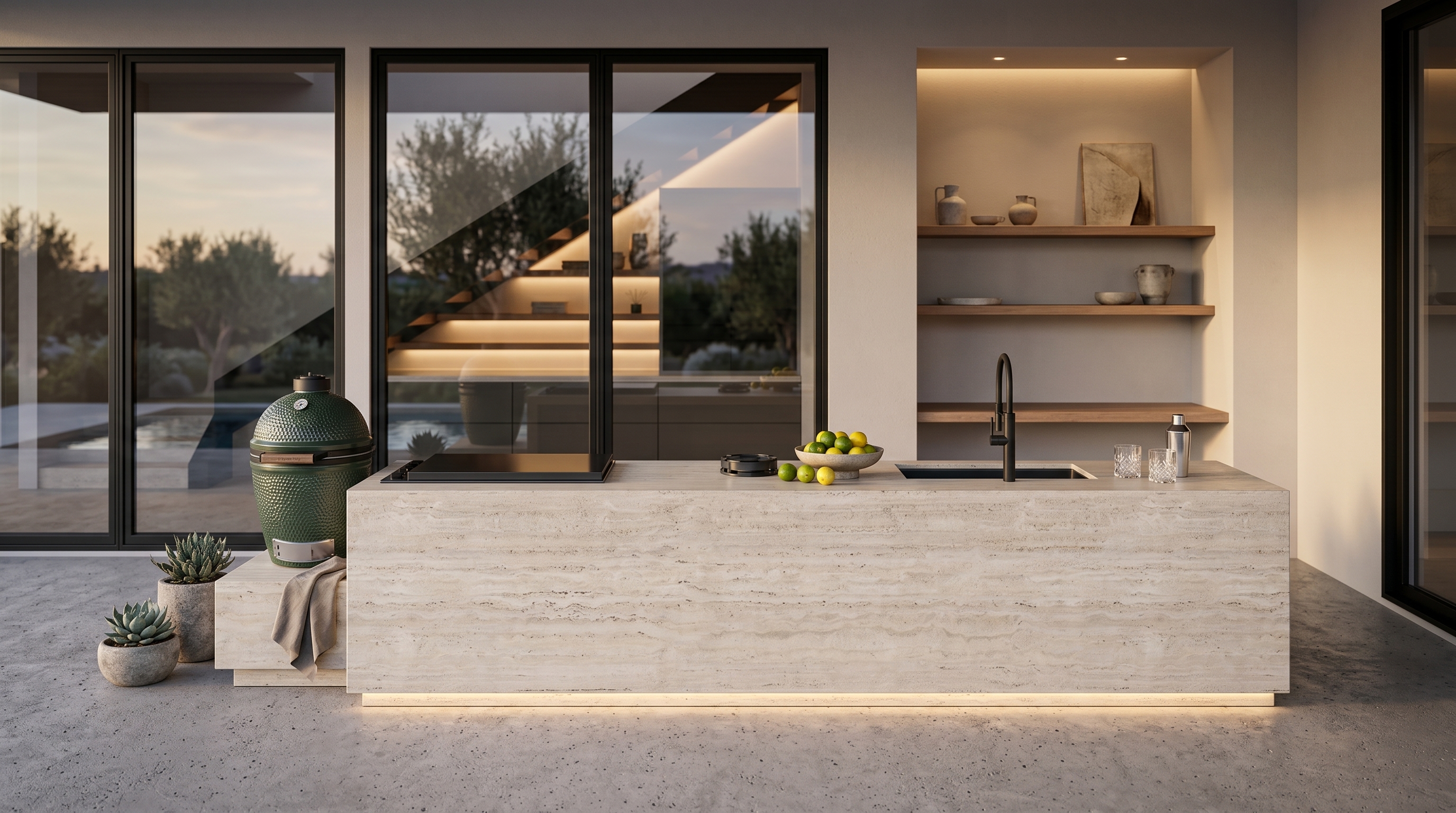
- Enclosure ventilation. Every built-in grill specifies a cutout and an airflow requirement. It is the most common failure in a custom outdoor kitchen, and it is a cabinetry decision, not an appliance one.
Answer those three and the grill becomes one component in a system engineered as a whole, alongside the enclosure and the surfaces around it.
BTU is a fuel bill, not a performance figure. The kitchens that cook well are the ones where somebody sized the box, the grate and the airflow before anybody read the hangtag. Buy the enclosure. The burner comes with it.
Book a private showroom tour
If this changed how you read a spec sheet, the next step is not another article. Book a private showroom tour and spend an unhurried hour with a BauTeam design consultant - in Atlanta, Boston, Burbank, Chicago, Dallas, Las Vegas, Los Angeles or New York - going through the enclosure, the ventilation and the materials with the appliance in front of you. Reserve your private tour.