
Craft
Quartz Is the Wrong Outdoor Kitchen Countertop
Quartz defines the luxury indoor kitchen, yet it is the wrong outdoor kitchen countertop: under UV it yellows within a season. Here is what survives instead.
Quartz is the surface that signals a serious kitchen indoors. It is engineered, consistent, faintly clinical — the material that says a homeowner has arrived. So it tends to follow people out the back door. When the conversation turns to the outdoor kitchen, quartz is the reflexive answer.
It is also the wrong outdoor kitchen countertop, and the failure is not subtle. Put engineered quartz under real sun and it begins to yellow — not over a decade, but inside a single season. The surface chosen to look expensive is the one most likely to age like something cheap.
This is the rare case where the premium indoor choice is the amateur move outside.
The resin is the problem, not the rock
Engineered quartz is not a slab of stone. It is roughly 90 to 94 percent ground natural quartz held together by 6 to 10 percent polymer resin and pigment. Indoors, behind glass, that resin is inert and the material is close to bulletproof. Outdoors it is the weak link.
Those polymer resins are UV-sensitive. Under direct sunlight they break down, and the binder that gives the slab its color begins to fade and yellow unevenly. Fabricators routinely report visible discoloration in under a year of real exposure. This is not a maintenance failure or an installation error — it is the material doing exactly what its chemistry dictates. Which is why most quartz manufacturers quietly exclude outdoor installation from their warranties. The clause is already written. The countertop is on its own the moment it leaves the shade.
Granite is safer — and more work than anyone admits
Granite is the usual fallback, and on the central charge it holds up: it is natural stone, it is genuinely UV-stable, and it will not yellow the way quartz does. That much of its reputation is earned.
The part the showroom skips is the upkeep. Granite is porous, and outdoors that porosity is a standing liability — rain, oil, citrus, wine. Keeping it sealed against the weather means resealing on a schedule most owners never hear about until it is too late: roughly twice a year in a freeze-thaw climate, once in spring and once before the first frost. Miss a few cycles and the "low-maintenance stone" starts wearing its stains permanently. Granite is not the easy answer. It is a commitment dressed as one.
What actually survives outside
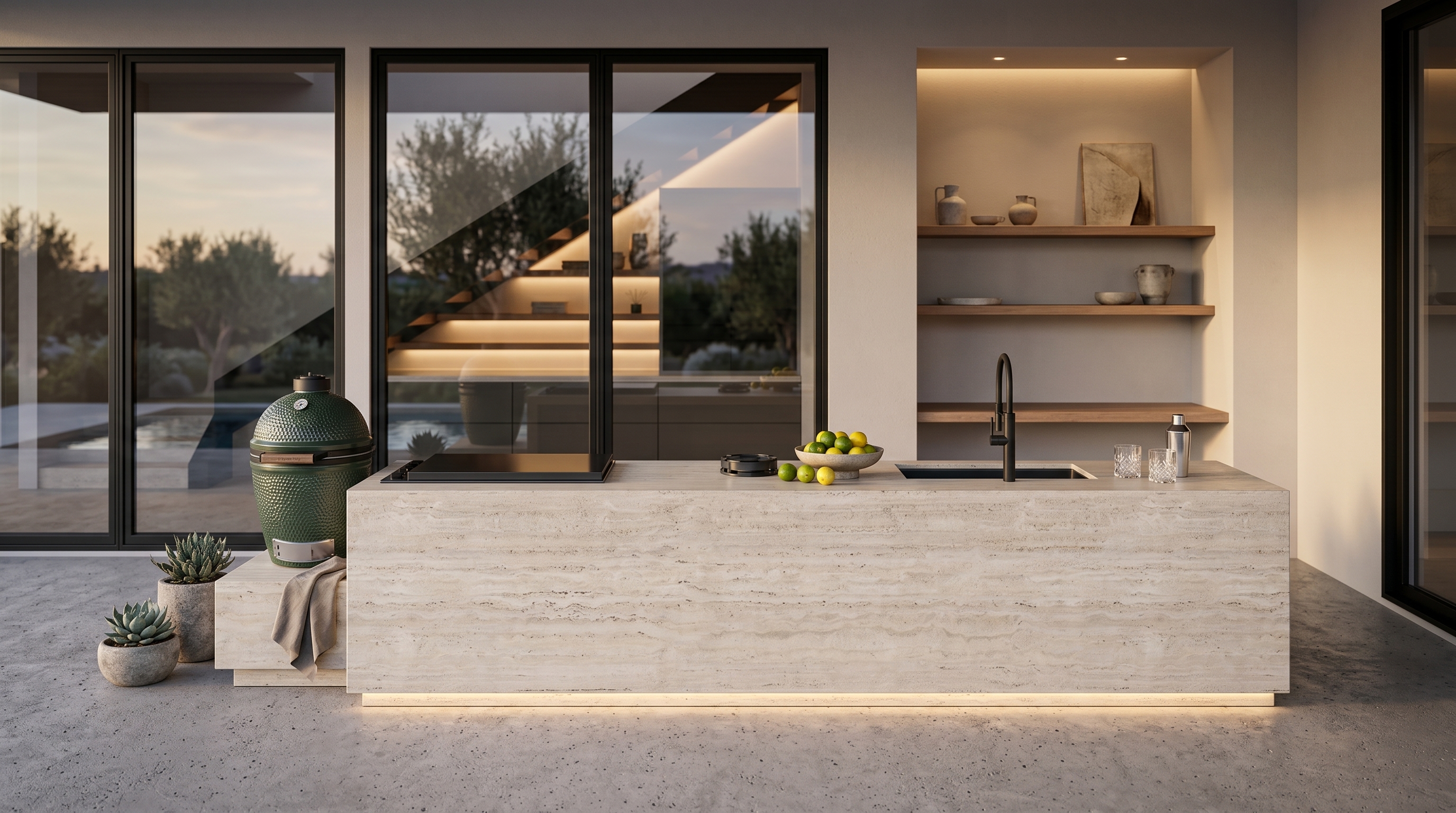
The surface built for this is porcelain. Large-format sintered porcelain is non-porous, so water and oil have nowhere to go. It is UV-stable, so its color holds without fading. It shrugs off heat and frost, and it never needs sealing. The maintenance schedule that haunts granite simply does not exist.
This is not a fringe position. It is why serious outdoor programs — our own included — specify engineered porcelain and full-body stone rather than the slab that happens to be trending in indoor kitchens. The material is chosen for the climate it has to live in, not the photograph it has to flatter.
What to do instead
If your outdoor kitchen sees direct sun for any meaningful part of the day — and most do — take engineered quartz off the table entirely. No finish, no color, no brand survives that exposure on the terms its warranty already admits.
Choose porcelain if you want the surface you can ignore: no sealing, no fading, no seasonal ritual. Choose granite only if you genuinely intend to reseal it on schedule, every year, for as long as you own the house. And before you sign anything, ask the fabricator one question in writing: what does the warranty say about outdoor and UV exposure? The honest answer tells you everything the brochure will not.
The takeaway
The outdoor kitchen is the one place where the most "premium" indoor decision quietly becomes the wrong one. Sunlight is not a finishing detail to design around — it is the client. Specify the surface that ages in it, not the one that surrenders to it.
Visit a BauTeam showroom
If this changed how you are thinking about your outdoor kitchen countertop, the next step is not another article. Book a private showroom tour and spend an hour with our design team, one on one — slabs in hand, in the light. We will walk you through what holds up outdoors and what only looks the part, at the BauTeam showroom nearest you. Reserve your private tour.