
Craft
Outdoor Kitchen Flooring Is Not a Finish Choice
Outdoor kitchen flooring gets specified last and looks fine dry. The standard written for grill areas asks for far more grip than the tile you were shown.
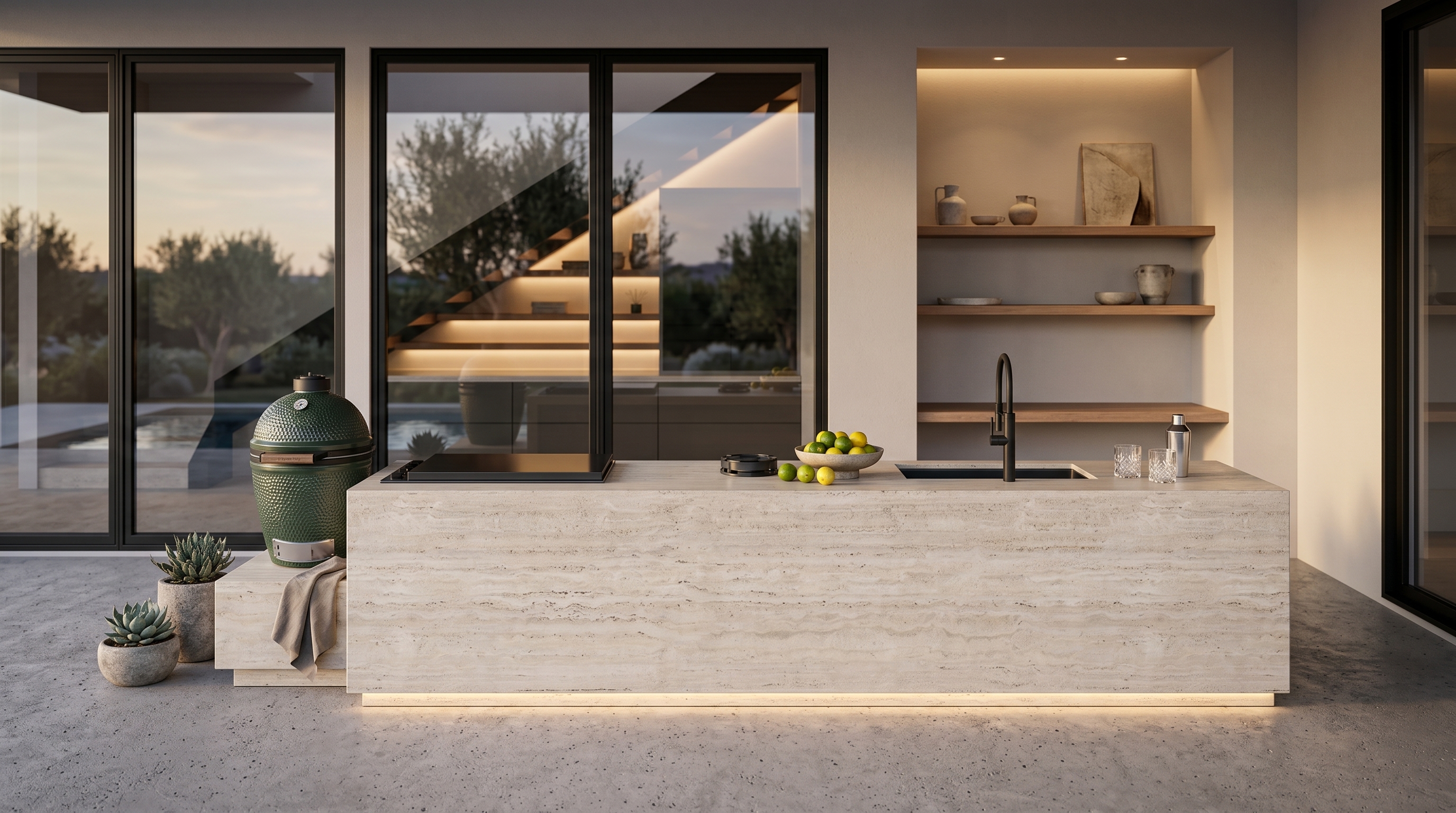
The outdoor kitchen gets designed from the top down. The grill, then the counter, then the cabinetry, then — somewhere near the end, usually after the budget has already been spent — the floor. It is treated as background. A paver, a slab, whatever matches the pool deck.
That order is backwards. Outdoor kitchen flooring is the only surface in the build that is simultaneously a walking surface, a drainage plane and a grease zone. It is also the one people cross carrying hot cast iron, barefoot, after a drink.
The bodies that write the standards understand this. The people choosing the patio usually do not.
Outdoor Kitchen Flooring Has Its Own Classification
In 2022 the Tile Council of North America added a five-category product use classification system to ANSI A326.3, the American National Standard for measuring dynamic coefficient of friction — the grip a hard floor offers underfoot when it is wet. The five categories are Interior Dry, Interior Wet, Interior Wet Plus, Exterior Wet, and Oils/Greases.
Read the last two again. The standard has a category for outdoor wet surfaces and a separate one for surfaces exposed to oils and grease, which its guidance describes as covering areas with grill and deep-fry equipment. An outdoor kitchen floor is the rare surface that is both at once.
The number most people have heard is 0.42. ANSI A137.1 requires tile recommended for a level interior space walked on when wet to reach a wet DCOF of 0.42 or greater. That is the indoor bathroom benchmark. For the Exterior Wet and Oils/Greases categories, A326.3 sets the minimum at 0.55 — a figure published by TileLetter, the National Tile Contractors Association trade journal, when the revision landed.
So the floor about to go under your grill is judged against a bar roughly thirty percent higher than the one most tile is sold against, and almost nobody asks for the classification.
The Sample You Approved Was Dry, Flat and Indoors
Every material decision in this category is made under conditions the material will never see again. The sample is handed to you dry, at eye level, under showroom light. DCOF is measured wet, because dry grip was never the problem.
Now add what actually reaches an outdoor floor: rendered fat carried off a grill on the soles of shoes, olive oil, spilled wine, pollen, and a film of algae on the shaded side by August. A large-format porcelain with a soft sheen photographs beautifully and behaves like soap under precisely those conditions.
Texture is what gets traded away. Smoother reads more refined and wipes down faster. It also becomes more dangerous the moment the surface is not dry — which, in the one part of the garden with a sink, a cooler and a hose, is most of the time.
The Floor Is Also a Drainage Plane
A patio near a house is not permitted to be flat. The International Residential Code requires impervious surfaces within ten feet of the foundation to slope at least two percent away from the building — about a quarter inch of fall per foot — a requirement the U.S. Department of Energy’s Building America Solution Center sets out in its guidance on site grading.
Two percent is invisible to the eye and glaringly visible to a cabinet run. Set a level island on a plane falling a quarter inch per foot and, across ten feet, you have two and a half inches to reconcile. Follow the slope with the cabinetry instead and every counter in the kitchen tilts, drawers drift open, and anything round finds the low end.
Serious builds solve this below the finish, with a level plinth or adjustable pedestal system that sits on the sloping slab and gives the cabinetry a true datum. It is invisible work, decided before the tile is chosen, and it is the difference between a kitchen that drains and one that ponds.
Ask for the Classification, Not the Photograph
Four questions, before anything is ordered.
What is the A326.3 product use classification? Not “is it slip resistant.” The classification. You want Exterior Wet, and across the cook zone, Oils/Greases. A supplier who cannot produce it has not tested for the condition you are building.
Is the porcelain certified? Standards define porcelain as impervious tile with water absorption of 0.5 percent or less under ASTM C373, and TCNA and the Ceramic Tile Distributors Association created the Porcelain Tile Certification Agency because non-porcelain is routinely sold as porcelain. In freeze-thaw country that number is the whole argument.
Where does the water go? Confirm the fall in writing, and confirm it runs away from the house and away from the appliance cabinetry, not into it.
Is the cabinetry independent of the slope? If the answer involves shims, keep asking. This is the first thing we resolve when we plan an outdoor kitchen, and it costs nothing to get right at the drawing stage.
One more move, which is free: zone the floor. Put the highest-traction material in the working strip — the two or three feet in front of the grill and the sink — and save the smoother, more refined slab for the dining and lounging side, where nobody is carrying a hot pan. It reads as a deliberate change of material, not a safety compromise, and it is how the best outdoor rooms are detailed anyway.
The countertop is what guests photograph. The floor decides whether anyone remembers the evening for the right reason. Specify it first and it disappears, which was always the point.
Book a Private Showroom Tour
If this changed how you are thinking about the ground under your outdoor kitchen, the next step is not another article. Book a private showroom tour and spend an hour with our design team, one on one — in Atlanta, Chicago, Dallas, New York or any of our eight U.S. studios — walking the materials, the drainage and the substructure before a single slab is ordered.